How to correctly assess heating output, room size and heating requirements
When considering buying a new stove, most people initially focus on design, fuel type and price. However, one of the most important questions is often overlooked:
How much heat output does my stove actually need?
5 kW, 7 kW or perhaps 10 kW? At first glance, higher heat output may seem to offer more flexibility. However, when it comes to stoves, bigger is not necessarily better. A stove that is too powerful can be just as problematic as one that is too small.
Floor area alone is not enough
You will often find specifications such as “suitable for 30 to 100 m²”. While these figures can provide an initial guideline, they are no substitute for assessing the building itself.
Two rooms of 50 m² each can have completely different heating requirements.
- Age and insulation standard of the building
- Size and ceiling height of the room to be heated
- Number and quality of windows
- Open-plan or enclosed room layout
- Adjacent rooms and stairwells
- Location of the stove
- Existing heating system
- Intended use of the stove
For example, a well-insulated new-build home requires significantly less heating output than an older, poorly insulated building of the same size.
Why a larger stove is not necessarily better
“Better to choose a slightly larger stove to make sure I have enough heating power.”
This may seem logical, but it is not necessarily the best approach when choosing a stove.
A stove operates most efficiently within the heat output range for which it was designed. If the stove is significantly oversized for the room, the temperature can quickly become too high. As a result, the user may drastically reduce the amount of wood or restrict the air supply.
This can lead to less efficient combustion. In addition, the stove loses some of the comfort it was originally intended to provide.
The goal should therefore not be to choose the largest possible stove, but one with a heat output that matches the building and its intended use.
What does “kW” mean for a stove?
The heat output of a stove is measured in kilowatts (kW).
The so-called nominal heat output describes, in simple terms, the heating output the stove is designed to deliver during normal operation.
A 6 kW stove is therefore not automatically suitable for a specific floor area. What matters is how much heat the building actually needs and how effectively that heat can be distributed.
In modern or renovated homes in particular, the actual heating demand can be surprisingly low.
Open-plan living spaces change the equation
The layout of the rooms also plays an important role.
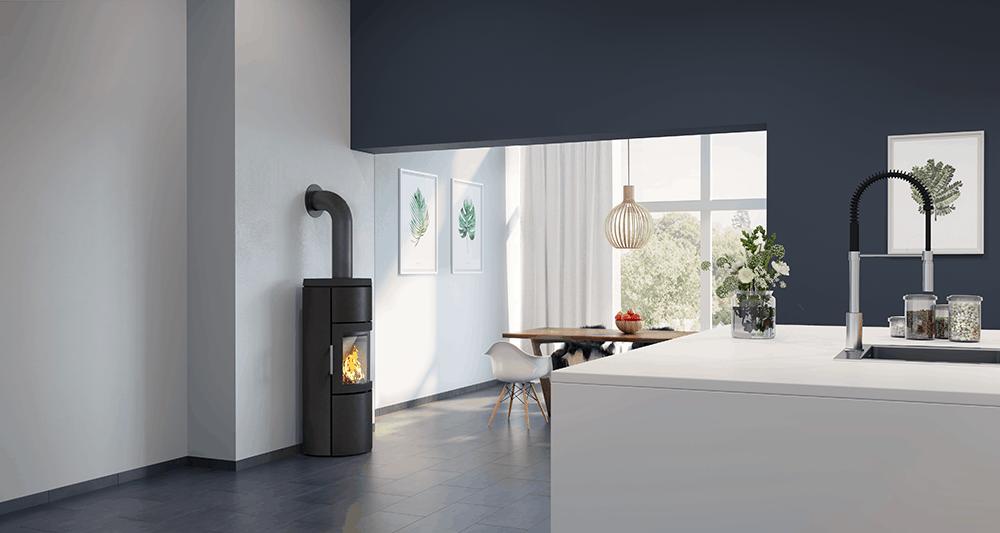
For example, if the stove is installed in an open-plan living and dining area with an adjoining hallway and open stairwell, the heat can spread across a much larger area.
In an enclosed living room, by contrast, more of the heat stays in the room where the stove is installed.
That is why, when planning a stove installation, we look beyond the room’s floor area and consider how the heat produced can actually circulate throughout the home.
Supplementary heating or a primary heat source?
Another key question is:
What do you want your stove to do?
Is it mainly intended to create a cosy atmosphere on evenings and provide extra warmth during the milder months between seasons? Or should it regularly heat a larger part of the house?
Someone who uses a stove occasionally to supplement their existing heating system has different requirements from someone who uses it for several hours every day.
Ease of use also plays a role. A traditional wood-burning stove offers a visible flame and a direct way of heating. A pellet stove, on the other hand, can operate automatically and regulate its heat output, depending on the model.
The right choice therefore depends not only on the building itself, but also on the daily lives of the people living in it.
The stove and chimney must be compatible
When planning the installation, the existing chimney must not be overlooked.
A stove always works in conjunction with its connected flue system. The chimney’s cross-section, height, route and condition must all be suitable for the appliance being installed.
In an existing building, it is therefore important to check whether the current chimney is suitable for the chosen stove before making a final decision.
If no suitable chimney is available, installing a new external chimney along the outside wall may be a solution, depending on the building.
Combustion air must also be taken into account
A fire needs oxygen.
In older buildings, sufficient air often enters the room through gaps in the building envelope. Modern homes and buildings that have undergone energy-efficiency renovations, by contrast, are much more airtight.
Depending on the building and the stove, an external combustion air supply may therefore be necessary or advisable. In this case, the air required for combustion is fed directly from outside to the stove through a separate duct.
This should also be taken into account as early as possible, particularly in new-build homes and extensively renovated buildings.
Plan first, then choose your stove
Of course, design plays an important role. After all, a stove remains a visible feature in your living space for many years.
From a technical perspective, however, the order should be reversed:
Building → Heating requirements → Installation location → Chimney → Appropriate heat output → Suitable stove → Design
This helps avoid choosing a stove that looks perfect but later turns out to be technically unsuitable for the house or significantly oversized for the room.
Our advice
If you are planning to install a stove, do not rely solely on general guidelines based on floor area.
Good stove planning takes into account the entire interaction between the building, intended use, heat output, combustion air supply and flue system.
We guide you through every step, from choosing the right stove and assessing the existing conditions to installation and connection to the flue system.
The result is more than just a stove in your living room — it is a solution tailored to your home and the people who live in it.
Let yourself be inspired and discover our stoves.