
Chimney sweeping
A clean flue means a healthy draught, a safe fire and a valid certificate. It’s the core of our trade – and the visit takes less than an hour.
Official certificate issued after every sweep – recognised by your municipality and your insurer.
All our services A SWEPT FLUE, A SAFE FIRE
EVERY VISIT INCLUDES
Room fully protected
Dust sheets down, fireplace sealed.
Mechanical flue sweep
In line with the rules of the craft.
Draught and soot check
Visual inspection of the whole flue.
Official certificate
Handed to you before we leave.
Site left spotless
Vacuum extraction, final check.
Safety first,
Paperwork included
Regular chimney sweeping is an important part of the safety and proper operation of any heating appliance.
Municipal regulations require regular sweeping, and your home insurance demands it in the event of a claim. Beyond the paperwork, a swept flue simply burns better : a healthier draught, less soot, lower fire risk.
Once a year is the minimum for a regularly used flue ; for primary wood heating we recommend two visits – before and during the heating season. You don’t have to keep track : we remind you when it’s time.
01 What we sweep, and what we check
We carry out sweeping and inspection work on a wide range of appliances and flue systems – from traditional wood-burning fireplaces and pellet stoves through to gas and oil heating systems.
In doing so, we check the condition of the installation and look for possible deposits, soiling or anything out of the ordinary. Regular maintenance helps to maintain the safety of the system, prevent faults and support efficient operation.
- Wood-burning fireplaces and inserts
- Wood-burning and pellet stoves
- Gas and condensing boiler flues
- Oil heating flues
- Connecting pipes and flue transitions
- Draught check and visual inspection
02 Blockages and bird nests
Where there are blockages – from bird nests, for example – we remove them properly and make sure the chimney can be used freely and safely again. We can then fit special protective mesh to prevent birds from entering and to guard against the problem recurring.
A nest is rarely the whole story. What has fallen from it sits further down the flue, out of sight, and a chimney that has been used with a partial blockage has usually been running badly for a season before anyone noticed. We sweep the full length before declaring it clear.
03 Camera inspection
Some faults a brush will never find. A camera inspection sends a video probe up the flue and shows its inner wall metre by metre – cracks, displaced liners, tar build-up, nests, a joint that has opened.
We run one as part of the annual check, and any time a heater misbehaves: poor draught, smoke pushing back into the room, an appliance that will not hold its fire. Rather than guess, we look – and you see the same screen we do.
The inspection tells us what is wrong and exactly where it sits. That is what turns a vague complaint into a precise repair, and it is where any relining work starts.
04 Soot, tar and the risk of a flue fire
Soot is the visible part, and the easy part. The one that matters is tar – the hard, glassy layer that forms when wood burns too cool or too damp, and that a brush alone will not always shift.
It narrows the flue, it holds heat where the flue was not built to hold it, and it is what burns in a chimney fire. Dealt with early it is routine work. Left through a few seasons it is how a liner ends up cracked.
Which is why we tell you what we found rather than only that the job is done. Damp wood, a stove run slowly for long stretches, an appliance too large for the room it heats – the deposits say how the fire is being run, and that is usually where the remedy is.
05 The certificate, and what it is for
Every visit ends with an official certificate, handed to you before we leave. Your municipality may ask to see it. Your insurer will ask for it after a claim, and that is the moment when not having one becomes expensive.
It records what was swept, what was inspected and on what date – keep it with the appliance paperwork. It is a short document, and it is the only proof that the visit happened.
What it costs
- Chimney sweeping for a wood-burning fireplace with insert or wood-burning stove 129€
- Sweeping / inspection of a pellet heating flue 160€
- Sweeping / inspection of a gas or oil heating flue 125€
- Duplex rate (each additional chimney in the same building) 55€
Prices include VAT. Anything beyond a standard visit is quoted at a fixed price before we start.
Book an appointmentThe result, no sales pitch
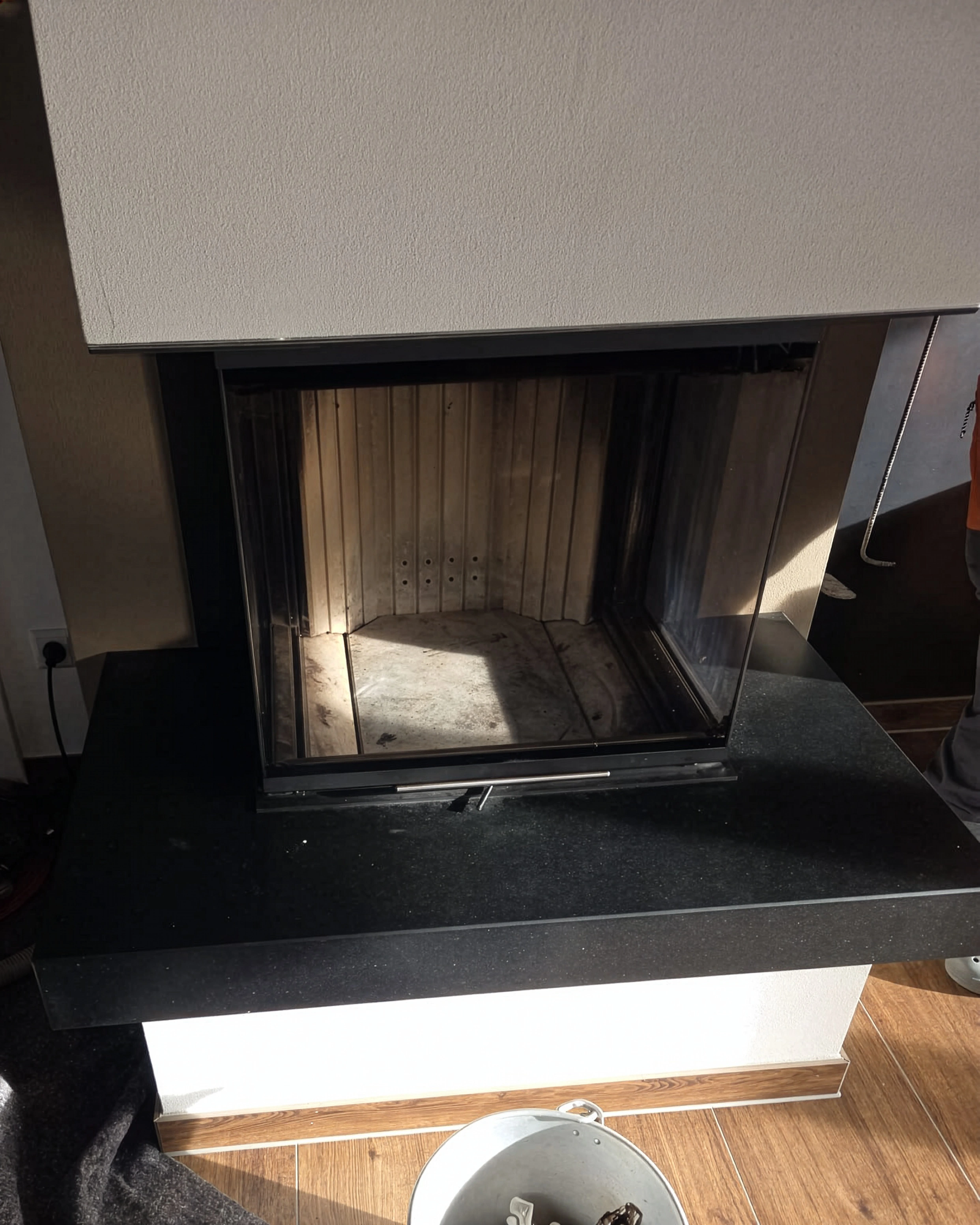
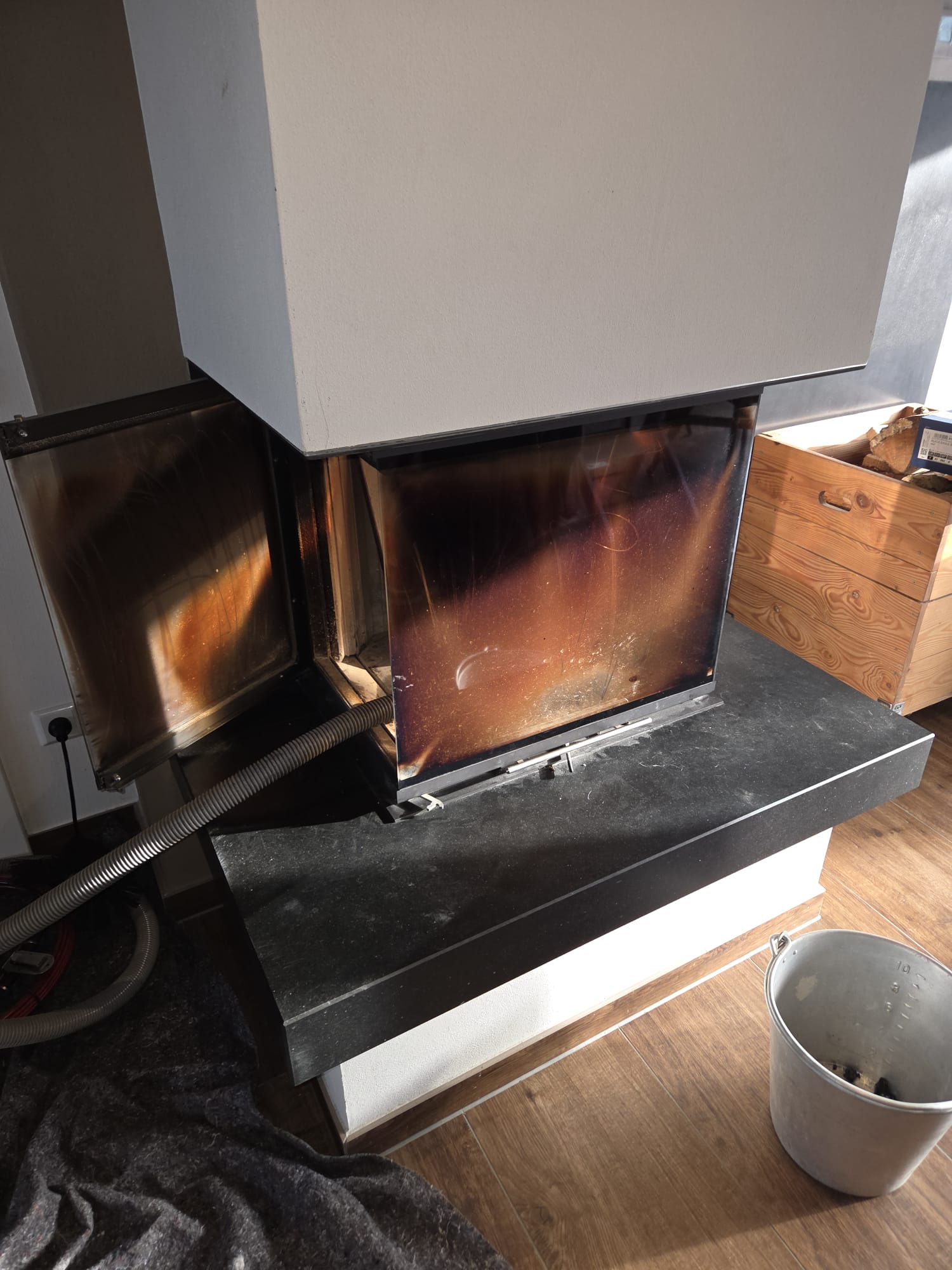
Drag the slider: each job site as we found it, and as we left it.
 BEFORE
Tarred glass and a sooted firebox brought back in a single visit.
Good to know
Another question? The simplest thing is to call us – we answer without jargon.
Yes. A video probe goes up the flue and shows its inner wall metre by metre. We run one during the annual check, and any time a heater draws badly or pushes smoke back into the room – it shows what the fault is and exactly where it sits.
At least once a year for a regularly used flue. For primary wood heating, we recommend two visits: before and during the heating season. We’ll remind you when it’s time – nothing for you to remember.
Yes. Municipal regulations require regular sweeping, and your home insurance demands it in the event of a claim. The certificate we issue after each visit covers you.
Allow 30 to 45 minutes for a standard sweep. We protect the room, sweep, check the draught and leave the site clean.
Yes. Recent flue fire, bird’s nest, smoke backing up: call the emergency mobile on +352 621 821 819 and we’ll arrange a priority visit. It is answered in the evening and at the weekend as well.
Yes, always. The official certificate is handed to you at the end of the visit – useful for your municipality and your insurance.